Average Reviews:

(More customer reviews)Are you looking to buy Relevance Lost: The Rise and Fall of Management Accounting? Here is the right place to find the great deals. we can offer discounts of up to 90% on Relevance Lost: The Rise and Fall of Management Accounting. Check out the link below:
>> Click Here to See Compare Prices and Get the Best Offers
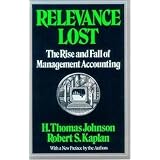
Relevance Lost: The Rise and Fall of Management Accounting ReviewRelevance lost of a book about the history of management accounting. The book is very well documented in that in times they were able to deduce different conclusions made by others. They start from the very beginning exploring as far back as the 18th century. They start out by discussing how textile mills started recording in their books accounting information. They begin from the very beginnings of accounting. Accounting emerged as a discipline in the early 18th century, but their underlying purpose in not for internal uses but it was created so that stakeholders can gauge the value of their investment in the firms that put out these financial statements. In the book there are a number of firms they highlight that made important contributions to management accounting. The first company they highlight is DuPont corporation in the nineteenth century. There is a theme to the development of management accounting. DuPont first staterted out as a manufacturer of gunpowder but went on to become bigger. The first companies that innovated their way of internal controls in management accounting grew out of a necessity. DuPont first came out with a measure of their business which was the return on investment measure. Because Dupont was becoming bigger and it needed to measure return on investment to measure the profitability of individual business units. It was a measuring rod to asses the different business activities of it business units. With this measure the managers of DuPont could make decisions such us which business units to invest on and do away with units that are performing poorly.In the 1920's at General Motors they have been experimenting with using variances to measure how well they are doing in their manufacturing. In to the picture is a man named Alfred Sloan, he is one of the most brilliant thinkers in management. With implementing variances GM was able to have a uniform way to impose standards to its managers. With this system, GM's growth became remunerative.
Then there came a period as the authors put it when relevance was lost. Financial accounting accounted for the bulk of the innovations in accounting leaving behind management accounting. This is like the "dark ages" of cost accounting when companies and academics did not innovate methods and processes to advance management accounting. There were a number of reasons for this, first is the requirement imposed in companies to generate financial statements for the stakeholders of the companies. Second, the cost of putting together the necessary information was prohibitive. Technology has not yet grown mature enough to allow managers to go through the trouble of compiling the information needed to make the decisions.
The beauty of this book is that it traces beginnings of topics that are familiar to us now. Topics like variances, discounted cash flow analysis, return on investment, sunk cost, and even just-in-time inventory systems. The next evolution of management accounting is to be led by academicians according to the authors. In this stage of the life of management accounting arose discounted cash flow analysis. This is a step ahead of the return on investment method. This is also a time when economist started to innovate management accounting further. The concept of sunk cost is introduced by economist in the London School of Economics. Innovations also arose by way of the field of operations research. Operations research deals primarily of mathematics. And about this time management accounting was taking hold as a discipline of its own. Along with discounted cash flow analysis, opportunity cost is introduces as well as agency theory and residual income. Residual income is interesting in that it was a step backward in the innovations of theories. Even though, GM started using this instead of the return-on-investment measure. The driving force of this period of the growth of management accounting is the need to have better decision making. This is why economics along with operations research contributed to the growth of management accounting.
Next up, management accounting in its evolved form before 1980 falls short. Management accountants make a couple of theoretical mistakes. They are no longer providing managers of the critical information needed to make decisions. Management accounting has become obsolete in a sense. The next development is what happened after 1980. Because of bitter and growing competition because of global forces and deregulation there needed to be more changes. In this period arose what is now called total quality management, and its progeny just-in-time systems. Manufacturers needed to control their work-in-process inventory. Meaning the Japanese where beating Americans by having zero inventory. This led to changes in management accounting systems throughout the United States.Relevance Lost: The Rise and Fall of Management Accounting Overview
Want to learn more information about Relevance Lost: The Rise and Fall of Management Accounting?
>> Click Here to See All Customer Reviews & Ratings Now

0 comments:
Post a Comment