Average Reviews:

(More customer reviews)Are you looking to buy Gold Medal Physics: The Science of Sports? Here is the right place to find the great deals. we can offer discounts of up to 90% on Gold Medal Physics: The Science of Sports. Check out the link below:
>> Click Here to See Compare Prices and Get the Best Offers
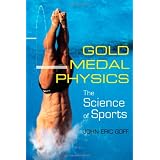
Gold Medal Physics: The Science of Sports ReviewInstead of repeating other reviewers, I focus mostly on unmentioned content, with a concentration on soccer.Vectors are used to decompose the motion of balls into their horizontal and vertical components. The angular motion of an ice skater is analyzed. The effects of air drag on a bicyclist are figured. There is a helpful bibliography of other books and articles which deal with the physics of sports.
A standard soccer ball, kicked at a speed of 5 m/sec, experiences a drag force of about 0.25 newtons. (Fig 7.7, p. 130). The corresponding numbers for higher speeds are: (7.5 m/sec, 0.5 newtons), (12 m/sec, 0.75 newtons), (15 m/sec, 1.0 newton), (18 m/sec, 1.5 newtons), and (20 m/sec, 2.0 newtons).
A sphere having a rough surface, as it flies through the air, experiences less air drag than a smooth sphere of the same diameter and flying speed. This owes to the fact that the rough sphere creates a boundary layer that is decoupled from the main air stream that is resisting the movement of the ball. In effect, the boundary layer serves as a "lubricant" relative to the air stream. At a speed of over 7 m/sec, the hypothetical perfectly-smooth-surface soccer ball would experience a drag force of about twice that of its actual non-smooth-surface counterpart. Baseballs, soccer balls, golf balls, etc., all experience the same phenomenon to varying degrees.
The interaction of the rotating boundary layer with the airflow around the kicked soccer ball is not symmetrical. This creates a force (the Magnus force) that causes the ball to curve as it flies through the air. The player who is kicking a penalty shot tries to get the ball to curve to an impact point in the corner of the net. When successfully executed, the goalie has almost no chance of stopping the kicked soccer ball.
Gold Medal Physics: The Science of Sports Overview
Want to learn more information about Gold Medal Physics: The Science of Sports?
>> Click Here to See All Customer Reviews & Ratings Now

0 comments:
Post a Comment