Average Reviews:

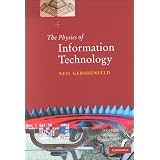
(More customer reviews)Are you looking to buy The Physics of Information Technology (Cambridge Series on Information and the Natural Sciences)? Here is the right place to find the great deals. we can offer discounts of up to 90% on The Physics of Information Technology (Cambridge Series on Information and the Natural Sciences). Check out the link below:
>> Click Here to See Compare Prices and Get the Best Offers
The Physics of Information Technology (Cambridge Series on Information and the Natural Sciences) ReviewWhen I first saw this book advertised, I thought it would be a painless way to fill in the gaps in my knowledge, e.g. in quantum computing and information theory. It indeed has a very wide sweep, an engaging style that is very clear and moves the reader along, an attractive design, and many other good points. I haven't checked all the math, but Gershenfeld seems most at home with theory.The problem is that when he touches on something I really am expert in, he falls on his face much too often. I don't mean just that he oversimplifies and leaves things out--how could he not--but that the book is full of genuine factual misinformation. Some representative examples: In 3.1.2, he confuses deterministic and stochastic processes completely, a confusion that persists throughout the extended discussion of noise; in 3.3.1, he says that shot noise dominates only for small arrival rates, whereas in reality it is dominant only in the limit of large rates; in 10.3, he's wrong about how bipolar transistors work, and wrongly says that their base current is why they aren't widely used in logic anymore; in the preamble to Chapter 12, he says that hard disk drives use "basically rust" to store information, whereas they've used plated metal for years, and that recording heads fly at 1 micron, whereas it's 50-100 times closer than that (120-200 angstroms). His discussion of modems wrongly says that 50kb/s+ modems rely on data compression for their speed, whereas the discrepancy is his underestimation of the S/N ratio of a good phone line.
And (most embarrassing of all for a theoretician) in his discussion of special relativity, he goes through a long derivation of the kinetic energy of motion, but makes an elementary integration error in the last line in order to (wrongly) display the famous mc**2.
Gershenfeld is clearly a very able guy who knows a lot about the physics of information technology--but I'd trust the book a lot more if I didn't keep tripping over these sorts of things. Let's hope the second edition is more carefully done.The Physics of Information Technology (Cambridge Series on Information and the Natural Sciences) Overview
Want to learn more information about The Physics of Information Technology (Cambridge Series on Information and the Natural Sciences)?
>> Click Here to See All Customer Reviews & Ratings Now

0 comments:
Post a Comment